

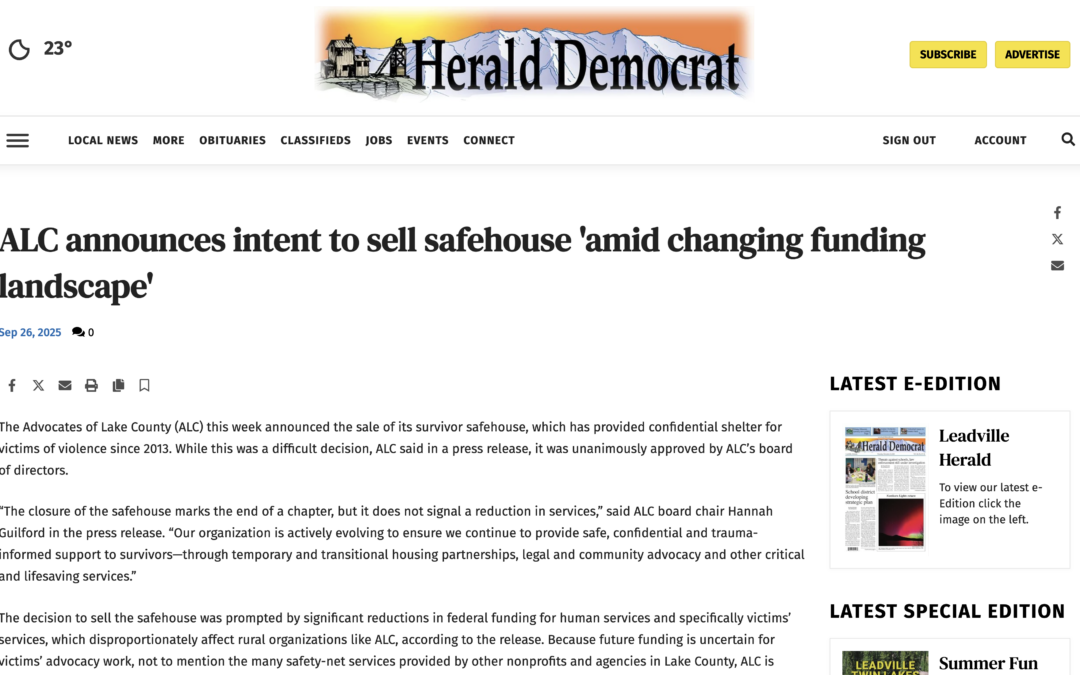
In September 2025, Advocates of Lake County (ALC) publicly announced plans to sell our survivor safehouse. We did this through a press release that was sent to local organizational leaders and the Leadville Herald Democrat; it is also available on our website.
You can find the listing on all major real estate sites, including Zillow, Homes.com, and Realtor.com. Our real estate agent is Amy Tait of Centennial Real Estate. If you’re interested in purchasing the safehouse, please contact Amy at leadvillere@gmail.com or 719-486-1409, or through one of the listing sites, for more information and to schedule a showing.
Below are answers to some of the most frequently asked questions (FAQs) about the safehouse sale.
- Who owns the safehouse?
- Isn’t ALC part of the City of Leadville/Board of County Commissioners? What about local law enforcement? Don’t they own it?
- Why does ALC need to sell the safehouse in the first place?
- How could local government let this happen?
- Who will benefit from the safehouse sale?
- What will happen to victims and survivors without the safehouse?
- Does this mean ALC is shutting down? What does ALC even DO if it’s not running a safehouse?
- How could you just spring this on us? Why didn’t you say anything sooner?
- What can community members do to help?
- Okay, but how do we save the safehouse?
- What if I have another question?
Click the questions that interest you, or scroll down to see answers to the whole list. We will maintain this this post with clarifications, additional questions/answers, and updates as new information becomes available.
Who owns the safehouse?
Advocates of Lake County owns the safehouse. We’re an independent 501(c)(3) nonprofit (EIN 84-0912821) organization and have been since our founding over 40 years ago.
Isn’t ALC part of the City of Leadville/Board of County Commissioners? What about local law enforcement? Don’t they own it?
Nope! ALC is an independent nonprofit organization that is not affiliated with Leadville City Government, Lake County Government, Lake County Sheriff’s Office, Leadville Police Department, or the 5th Judicial District. We’re called “Advocates of Lake County” because Lake County is where we operate, not because the County Government runs the organization. We’re our own thing.
Although we work closely with these and other organizations and entities in the community, we operate independent of them just like any other business. Our budgets, our strategies, our staff, and our funding are completely separate from one another’s.
Why does ALC need to sell the safehouse in the first place?
Most of our funding comes from State and Federal grant programs — and a lot of State grant programs are also Federally funded, so changes on the Federal level often affect State grants too. Earlier this year, the Federal government cancelled over $800 million in funding for gun-violence prevention, sexual assault and domestic violence services, and victim advocacy programs — with more cuts promised. While some funding has technically been reinstated (meaning, they allowed organizations to submit applications), decisions have not actually been announced, funds have not actually been awarded, and it’s unclear if those grants will actually award and distribute funds or not.
For example, just one of those grants provides $250,000/year to ALC for rural violence prevention and response work, including educational programs for youth and adults and counseling for victims of abuse, so that’s a huge hit for us. And that is just one example; multiple funding streams are affected by cuts, elimination, and uncertainty.
Since we don’t know WHAT is going to happen next, we have to be smart with what we DO know. And what we DO know is we can sell the safehouse and use the money from that asset to plug gaps so we don’t have to sacrifice essential services. This will allow us a way to make up for funding gaps as we look for long-term solutions to this sudden, massive change in funding.
How could local government let this happen?
ALC is not a government entity. So, the short answer is, they don’t get a vote! Because ALC is an independent organization that operates like any other private business, we’re not controlled by local government. Local government also doesn’t pay for ALC. Like other community nonprofits, ALC participates in annual calls for local grant requests to groups like the Board of County Commissioners and the Lake County Community Fund, but those award amounts are small — unless they’re required as part of some Federal disbursement (like during COVID).
Our largest source of funding is Federal and State grants — most of which have seen massive cuts and many of which may not even exist next year. As supportive as local government is, they can’t make up hundreds of thousands of dollars in lost funding for a single organization, especially not when multiple other local organizations are suffering from funding cuts too.
There’s only so much local government can do to fund our work — and from our perspective they’re doing what they can. In 2025, for example, ALC got $15,000 from the BOCC for our homelessness program, which helped to fill a funding gap when our homelessness program’s rent went up but the grant budget was already set for the year. It was INCREDIBLY helpful to address that problem, but that amount represents around 1% of our total organizational budget.
The main problem with funding is insufficient Federal government funding, NOT issues with local government funding. In a community this small, there’s only so much to go around.
Who will benefit from the safehouse sale?
The whole community, and our neighboring communities too — because the sale is going to allow ALC to weather the storm of funding uncertainty we’re facing for the foreseeable future. When a community has resources to support the most vulnerable, the entire community benefits.
If the real question is, “Who gets the money?” the answer is ALC. The proceeds from the safehouse will go back into ALC’s general operating fund to cover everything from staff salaries and office rent so we can keep providing services to emergency hotel stays, plane tickets, legal fees, rental assistance, medical bills, and more to help our clients get and stay safe.
What will happen to victims and survivors without the safehouse?
We’re shifting to a flexible sheltering model that better serves our small rural community. After all, it’s kinda hard to keep your location a secret for long when the whole town is 1 square mile! Flexible sheltering includes options like local and distant hotel stays, transportation to a safer area far away from a perpetrator if it wouldn’t be safe to stay in the community, using a variety of options to help folks move into longer-term stay solutions in and around the county when it’s safe to stay nearby, etc. We’ve ALWAYS done this to some extent, and we’ll be able to do a lot more when we reduce our overhead costs by selling the safehouse.
It’s important to note that domestic violence advocacy organizations around the country and even in neighboring communities have operated without a safehouse for decades. ALC did it for 30some years, so we already know it works here too. A single-site location is not necessary to serve survivors, and in may cases it’s also not ideal. Many survivors in small communities do not feel safe being sheltered in that community because it would be easy for their abuser to find them — or because their abuser already knows the location. While our safehouse has absolutely been a refuge from the storm for many over the last 12 years, it’s also far from the only place we’ve housed our clients. People in need will still receive safe shelter. They’ll just receive in alternate locations that meet their individual needs.
Does this mean ALC is shutting down? What does ALC even DO if it’s not running a safehouse?
Absolutely not! While it’s true that rural communities like Lake County stand to be disproportionately affected by federal funding cuts, ALC is NOT shutting down. We’re taking swift action to protect ALC from the impact of those funding cuts.
Selling the safehouse gives us critical cash reserves to continue the rest of our critical and life-saving services, which include but are not limited to the following:
- Our 24/7 crisis hotline, which provides free, confidential support to victims and survivors of domestic violence, sexual assault, and human trafficking all day every day. (Anyone calling the hotline will learn about the services below that may be of use to them, if they want to hear about them; some folks call because they just need a listening ear and they know we will believe them and support them.)
- Remote Crisis Response, in which our advocates provide a safe and confidential listening ear, information about options, resources to pursue those options, and emergency services like transportation, shelter, and basic supplies.
- On-Site Crisis Response/Co-Response, in which our advocates respond on site to a request from a client or from law enforcement related to domestic violence; physical or sexual assault and abuse; human trafficking; and other violent crimes. (Clients may receive any or all of the services we offer outside of the immediate crisis.)
- Safety planning, in which our advocates support clients to design a personalized plan to stay as safe as possible in a dangerous relationship and, when they’re ready to leave, to do so safely with a clear game plan for their next steps.
- Case management, in which our advocates walk through every step of the journey with our clients, especially helping navigate resources and manage all of the moving parts of their plan to get and stay safe; this may be the most important service we offer, because it helps all of the other services work together effectively and supports our clients to move forward without becoming overwhelmed or discouraged.
- Assistance with protection orders, in which our advocates help clients assess for themselves the benefits and risks of obtaining protection orders, prepare for pursuing a protection order if they choose to, understand what to do when a protection order is violated, identify (and pay for) qualified legal assistance if needed, and more.
- Personal advocacy, in which our advocates help clients do essential tasks like filling out rental applications, exploring benefits eligibility, accessing medical care, hunting for a job, and pursuing education to open up career options; attending appointments with clients; researching relocation options; finding professional assistance like counseling and financial advice; and more.
- Medical advocacy, in which our advocates meet a client at the emergency department or a private medical facility (and sometimes even drive them there) on request to provide emotional and practical support during a forensic exam (which might include a sexual assault exam or “rape kit” or an exam for injuries from other kinds of physical assault) or follow-up from a forensic exam or other procedures related to the abuse/assault they experienced.
- Court advocacy, in which our advocates appear in court with clients and/or their families on request and to make new potential clients aware of the free and confidential services available to them.
- Flexible financial support, which can include things like rental assistance to help a client secure their own safe place to live, utility assistance to keep basic services available in their home amid turmoil, purchasing a plane or bus ticket to help with relocation to a safe area away from an abuser or attacker, purchasing basics (e.g., food, clothing, toiletries), paying an overdue bill to get a cell phone turned back on so a client has a way to call for help when they need it, and more.
- Legal services, in which our advocates make referrals to qualified legal professionals and cover a portion or all of our clients’ legal costs for civil and immigration matters; attending attorney meetings with clients for emotional support or practical support like taking notes, amplifying their voice, and filling out forms with them; and providing resources and basic information about legal processes (like what happens when you file for a temporary order of protection).
- Safe shelter, which takes many forms including referrals to other programs in other areas (if Lake County isn’t safe), emergency hotel stays, extended hotel stays, short-term rentals, and more.
- Community education, which includes awareness activities, trainings, collaboration, referrals, and both prevention and response work in a variety of settings including in person, in print, and online.
Please note that all services from ALC are free, confidential, and wholly client directed. We offer options and each client decides what they do want and don’t want at any given time. They define their own safety, and we support them to create it and maintain it.
How could you just spring this on us? Why didn’t you say anything sooner?
We’ve been talking about threats to funding for human services, including DV/SA programs, violence prevention, and more, all year. It started with pleading for your support during the government funding freeze in January; we even provided outreach templates for advocating to elected officials. We held extra fundraisers in February and April. In May we launched a new fundraising campaign, Operation: Safety Net, to address funding instability, and have promoted it on email, social media, and our website. In June we pivoted our Empowerment Express event to a no-overhead online-only auction specifically because of funding instability.
While the September announcement of the safehouse sale may have been surprising to some, it came on the heels of months of both national and local discussion about Federal funding cuts for victims’ services, including in the August 15, 2025, Leadville Herald Democrat article “A closer look at domestic violence in Lake County,” as well as in multiple social posts, emails, website content, and fundraising campaigns from ALC. We directly emailed dozens of organizations and agencies in and around Lake County before the press release was printed. We also had multiple meetings with elected officials including Senator Michael Bennett, Representative Brittany Pettersen, and local government, as well as other nonprofits in Lake County, for months before the announcement, as well as after.
Additionally, the ongoing discussion of funding challenges and the safehouse sale announcement were followed by a letter to the editor from ALC’s co–executive directors published by the Herald Democrat in October (also available on our website); a multi-day indoor yard sale offering furniture, housewares, clothing, and other supplies to the community on a “take what you need, pay what you can” basis; a substantial clothing donation to St. George for distribution to guests taking advantage of food supports; and finally the official real estate listing going live the week of November 16 (see announcement on Facebook and view listing on Zillow).
What can community members do to help?
The No. 1 most important thing you can do to support ALC is to advocate for full and expanded funding for victims’ services at the State and Federal levels. The Department of Justice, which includes the Office on Violence Against Women, and the Department of Health and Human Services, which includes the Centers for Disease Control and their Violence Prevention program, saw cuts of over $800M this year. That is catastrophic for most agencies like ALC. Fortunately, we have an asset we can sell to fill gaps; most similar organizations do not have that, and as a result will be cutting positions and closing their doors.
How to contact our elected representatives for Lake County/State of Colorado:
- Send a written message to 📬 Colorado Senator Michael Bennet or call his Washington, DC, office at 📞 202-224-5852
- Send a written message to 📬 Colorado Senator John Hickenlooper or call his Washington, DC, office at 📞 202-224-5941
- Send a written message to 📬 Colorado State Representative Brittany Pettersen (District 7; scroll down to the bottom of the page) or call her Cañon City District Office at 📞 719-458-6161
- If you’re outside of Leadville/Lake County and not sure of your district or who your representative is, here’s a full list of Colorado State Representatives
There are also free apps you can use to make outreach easier. Our favorites are 5 Calls and ResistBot.
The No. 2 most important thing you can do to support ALC is by making unrestricted cash donations. Most of the grant funding we have is restricted, meaning it can be used only for very specific purposes and for people who meet stringent eligibility criteria. (To be clear, that’s a decision the funders make, not something we choose.) That means that if we don’t have a grant that allows us to cover what a client needs, we can’t actually provide it because we don’t have a way to pay for it. For example, some funding is only for women with kids under 18. But what about a mom whose last kid is out of the house and she’s finally ready to leave? That specific restricted funding cannot cover her services. Unrestricted funds allow us to support EVERYONE who needs help, not just the people who check certain boxes. Unrestricted funds also allow us to be nimble, flexible, and adaptable as community and organizational needs change.
You can donate directly to ALC online through Colorado Gives, or you can mail a check to us at Advocates of Lake County, PO Box 325, Leadville, CO 80461.
Okay, but how do we save the safehouse?
There is no saving the safehouse. We can keep the house and risk the organization, or we can protect the organization and release the house. We choose to keep serving victims and survivors no matter what it takes — and in the current funding environment, what it takes is selling the safehouse.
It does not make financial sense for ALC to use what little unrestricted funding we have on overhead for the facility and staff time to run the safehouse when we could use all of that funding directly for serving clients with the myriad other ways we can help. ALC is mission driven, not building driven. Selling the safehouse is part of how we continue delivering on our mission.
And to be clear, now that the safehouse location is officially public, there is absolutely no way we can use it again to provide confidential shelter. It’s now the opposite of confidential. That’s why we were very intentional about safely relocating our remaining guests well before our yard sale and the public real estate listing — for their safety and for our staff’s safety. We are open to the possibility of owning a different secure location in the future, but only if that makes sense for the organization and our clients’ needs at that time. For now, we are staying as lean and nimble as possible to get through this stormy season. When the organization’s future is again secure for the long term, we can revisit the idea of a single-site secure shelter. Until then, we’re focusing on short-term and mid-term security, and that means selling the safehouse.
Please help us help the community by advocating for funding at the State and Federal levels (see above), donating when you can, and sharing the safehouse listing to help accelerate the sale.